


Cloud Architecture.
Generally speaking, the architecture of a cloud computing environment (Cloud) can be divided into 4 layers: the hardware/data center layer, the infrastructure layer, the platform layer and the application layer.
The hardware layer: This layer is responsible for managing the physical resources of the cloud, including physical servers, routers, switches [1] , power and cooling systems.
In practice, the hardware layer is typically implemented in data centers. A data center generally contains thousands of servers that are organized in racks [2] and interconnected through switches, routers or other structures.
The infrastructure layer : Also known as the virtualization layer, the infrastructure layer creates a pool [3] of storage resources and computing resources by partitioning physical resources using virtualization technologies.
The platform layer: Built on top of the infrastructure layer, the platform layer consists of operating systems and application frameworks. The goal of the platform layer is to minimize the burden of deploying applications directly to Virtual Machine (VM) containers.
The application layer : At the highest level of the hierarchy, the application layer consists of the actual cloud applications. Unlike traditional applications, cloud applications
can take advantage of the automatic scaling feature [4] to achieve better performance, availability and lower operational cost.
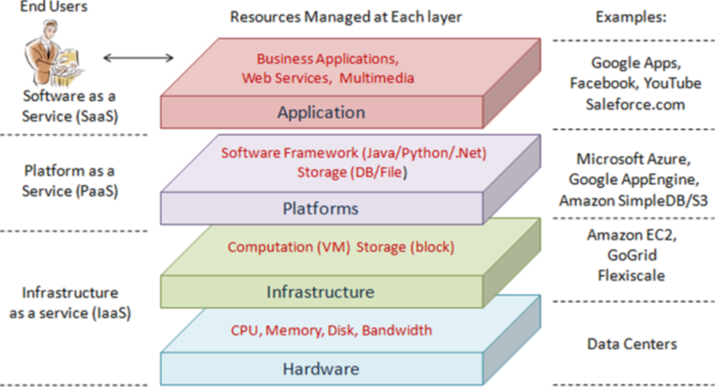
Figure 1 Cloud architecture
Source: (Zhang et al., 2010)
[1] https://www.cisco.com/c/pt_br/solutions/small-business/resource-center/networking/network-switch-vs-router.html#~switches [2] https://www. racksolutions.com/news/blog/what-is-a-relay-rack/ [3] https://learn.microsoft.com/pt-pt/azure/devops/pipelines/yaml-schema/pool?view=azure -pipelines [4] https://dicionario.priberam.org/escalonamento


Comments